


Venturithm
Simulation Platform Development and UX Redesign
Bernd Wurth
Turning Complex Venture Modelling into a Clear, Scalable Learning Platform
Objective
Venturithm was created to help early entrepreneurs, students, and educators simulate real business scenarios. The founder, Bernd Wurth, a university academic, wanted a platform where users could input financial, operational, and strategic assumptions and instantly see how their venture would perform over time.
The concept behind Venturithm was powerful, and the early prototype provided a solid foundation to build on. As the platform grew, it became clear that the user experience needed more structure to support the increasing number of inputs, steps, and interactions.
The goal of LOOPSIO’s collaboration was to transform his early vision into a cohesive learning cloud-platform with intuitive user flows, clear visual communication, and a scalable structure fit for academic programmes and entrepreneurship training.

What We Delivered
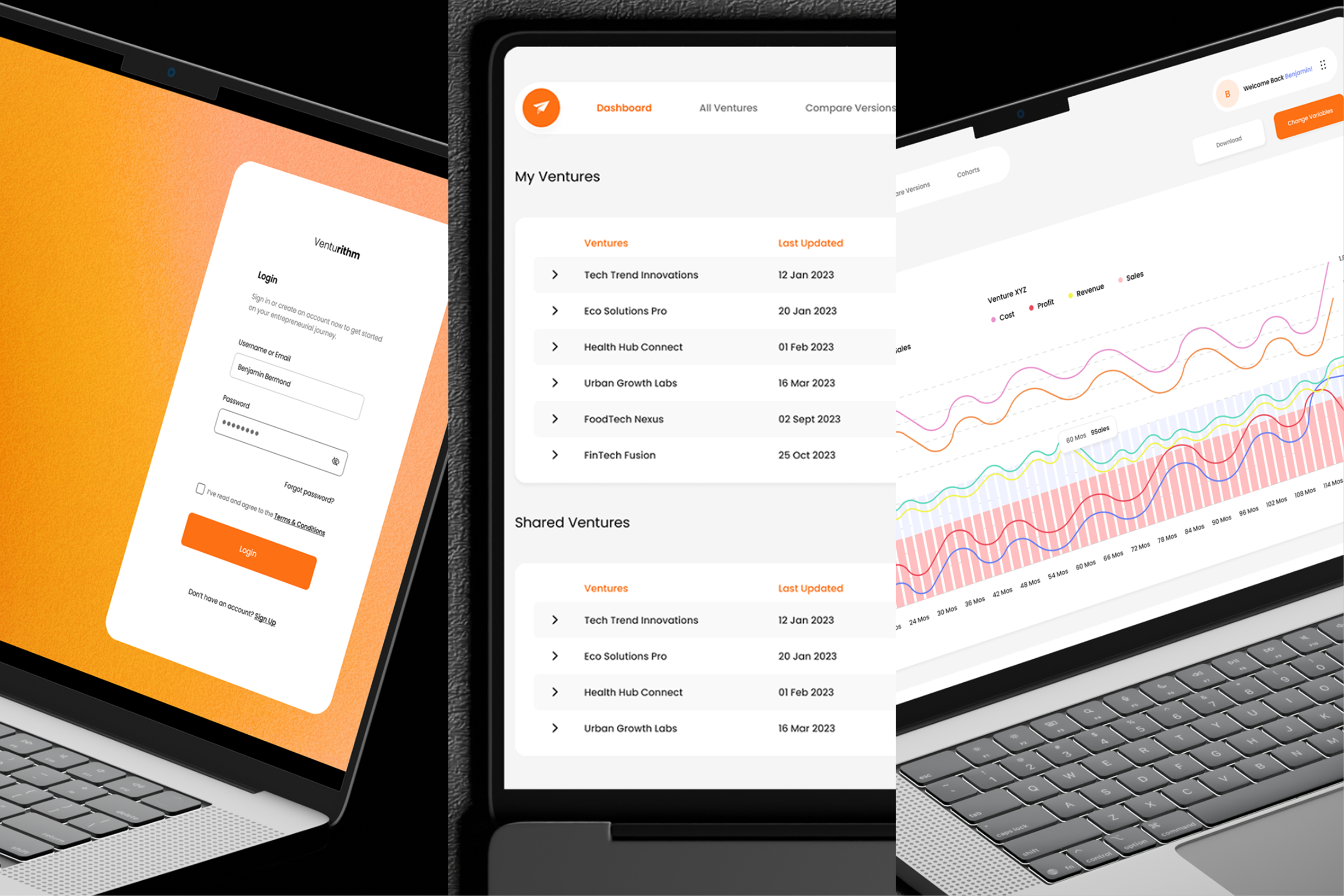
A Complete UX Design for Clarity
Venturithm’s early vision was technically ambitious and game-changing for how entrepreneurship is taught and modeled in the real-world. We developed the underlying infrastructure, and designed the platform based on Bernd’s research and expertise into a simulation that mirrors how startups and businesses are actually built and evaluated.
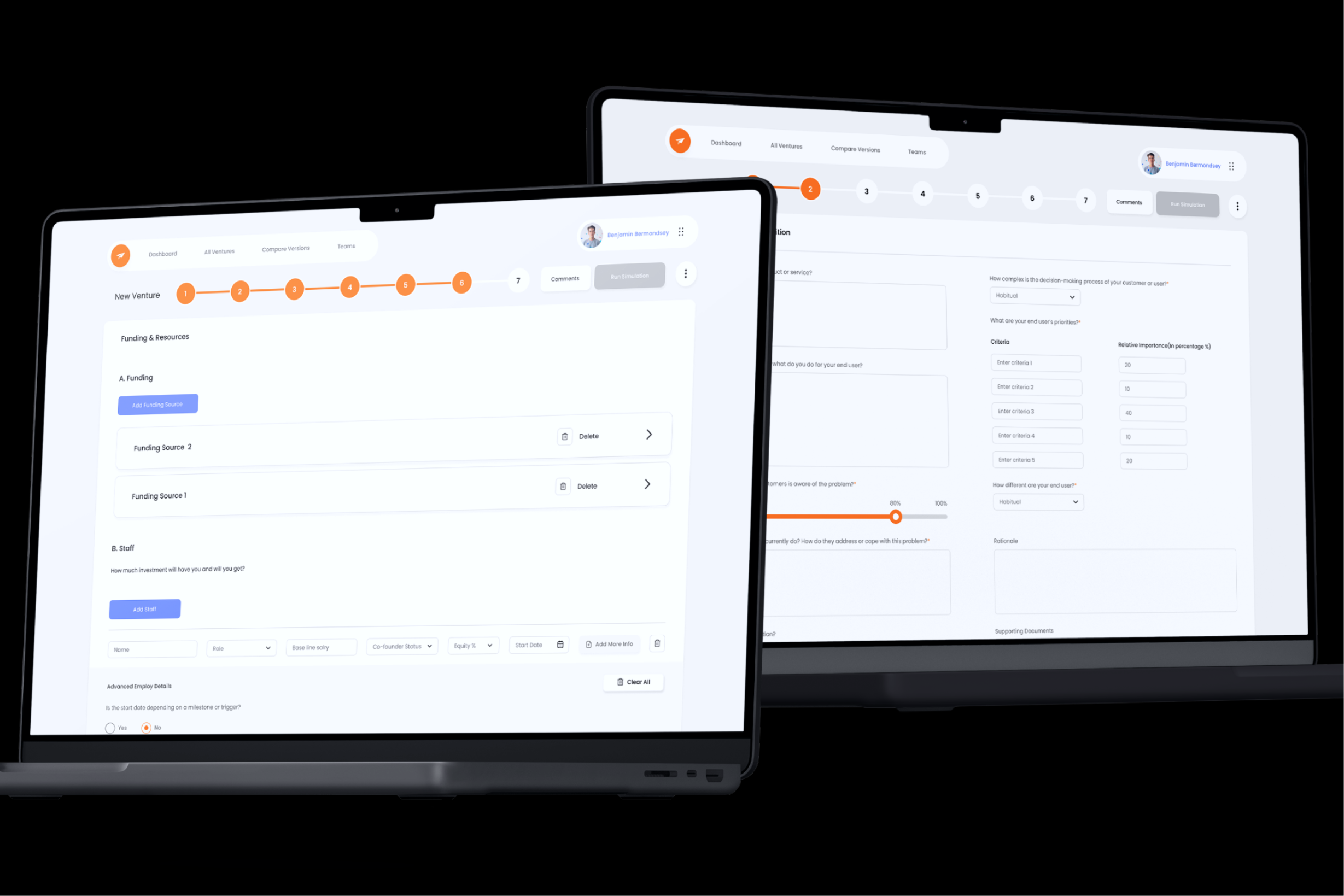
• Reframed the venture creation process into clear, logical stages aligned with entrepreneurial decision making
• Simplified navigation and reduced cognitive load through structured progression
• Transformed a complex interface into an intuitive learning experience without sacrificing analytical depth
A Scalable Design System
To support long-term growth, we introduced a unified structure that ensures consistency and adaptability as the platform evolves.
• Established a coherent design system and visual hierarchy across all screens
• Standardised interaction patterns to improve clarity and user confidence
• Built a flexible foundation that allows new features to be added without disrupting the core experience
Visualisation of Complex Simulations
The strength of Venturithm lies in its simulation engine. Our focus was to ensure results generate insight, not confusion.
• Translated complex modelling outputs into structured visual and comparative views
• Enabled scenario exploration to highlight cause-and-effect relationships
• Balanced academic rigor with accessibility for students, educators, and early entrepreneurs

Our Approach
Collaborative, Iterative Design
The designer worked hand-in-hand with the development team, delivering screens weekly to match implementation speed. Because Venturithm is a deeply technical tool, we ran multiple design-discovery sessions with the founder to understand the financial logic behind each input.
User-Centric Thinking
We tested the early prototype internally to identify friction points:
• Where users hesitated
• Where information was unclear
• Where navigation broke the flow
• Where cognitive load was too high
This guided the redesign and ensured the platform was accessible even for users without a background in finance.
Flexible Foundations for Future Growth
Because the founder planned additional features for later phases, we designed a structure that could grow without major redesigns. This ensured long-term sustainability and reduced future development costs.
Challenges We Overcame
• Transformed a technically complex, academically rigorous simulation into an intuitive and accessible user experience without compromising analytical depth.
• Designed a complete, coherent interface from the ground up, establishing structure, hierarchy, and clarity where no prior design system existed.
• Navigated a highly specialised domain efficiently, aligning closely with founders and developers to accelerate progress without disrupting parallel development cycles.
• Structured large volumes of interdependent data into a manageable, learning-ready platform prepared for real academic pilots and institutional use.
Results
• Positive feedback from university users who rated the new interface clearer and more supportive.
• Increased adoption, with more institutions interested in piloting the platform.
• Stronger simulation interpretation thanks to visual graphs and structured result displays.
• A scalable and cohesive product ready for real-world teaching environments that supports long-term expansion without extensive redesign.
Conclusion
Venturithm showcases LOOPSIO’s ability to bring clarity to complex products. Through thoughtful UX, consistent UI, and close collaboration with both developers and the founder, we turned a technically heavy simulation tool into an approachable and scalable platform.
It is now a product capable of supporting students, educators, and early entrepreneurs as they explore real venture modelling. Venturithm stands as an example of how LOOPSIO transforms early prototypes into professional products that balance usability, technical depth, and long-term scalability.